The successor
to RPA
Not rip-and-replace. A practical path from bot estates to governed agentic operations.
Traditional RPA executes prescribed clicks. Agentic AI works inside enterprise context, reasons across workflow data, uses policy-bound tools, and can close work with evidence. In most enterprise estates, that makes it the next operating model, not merely the next tool. ServiceNow provides the workflow fabric enterprises already trust, making it the natural operating layer for governed, observable, policy‑bound agentic AI.

The Markerstudy signal: RPA estates are starting to collapse under their own weight
RPA helped remove manual repetition, bridge legacy gaps and create quick wins where systems could not easily talk to one another.
In practice, many RPA estates have become operational overhead: too many tools, rising licence and support costs, duplicated capabilities, fragile UI‑driven automations, limited observability, and bots compensating for broken processes rather than fixing them at source.
The opportunity is to consolidate, rationalise and redesign around native workflow, APIs and AI, retaining automation only where legacy interfaces make it unavoidable, and introducing AI disposition where autonomy adds value.
Markerstudy: RPA estate assessment and modernisation
An assessment identified 457 automations across RPA platforms including Automation Anywhere, Blue Prism, Kofax, Nintex and UiPath. Findings included tool sprawl, tactical workaround bots, and contracts running September 2025 to April 2028, driving a consolidation and redesign path around native workflow, APIs and AI.

From scripted tasks to governed decision execution
ServiceNow Agentic AI changes the centre of gravity. Instead of automations that mimic clicks, agents operate inside workflows, use enterprise context, coordinate across systems, and act under policy with audit, telemetry and approval thresholds. Hitachi Digital Services' managed services model reinforces that shift with governance, observability, drift control, reliability SLOs and continuous optimisation through HARC for AI and R2O2.ai.

-
Works from an enterprise context
Uses workflow context, CMDB, knowledge and approvals to act with the enterprise’s memory and policies. -
Orchestrates work, not clicks
Plans and acts through agents and orchestrators to move work across teams, systems and approvals.
-
Acts through APIs and tools
Uses APIs, tools and enterprise systems already in place instead of relying on UI stability. -
Built-in governance signals
Creates auditable telemetry, cost and outcome signals by design, with human approval thresholds for higher-risk actions.
Shrink cost before scaling ambition
Retire low-value, duplicated, file-based or workaround bots. Reduce tool sprawl and overhead by eliminating automations that compensate for process weaknesses rather than fixing them at source.

-
What to retire
Low-value, duplicated, file-based or workaround
bots. -
Why retire
Too many tools, rising licence/support costs, duplicated capabilities.
-
What replaces them
Eliminate or replace with native workflow, APIs, or lightweight scripts embedded in the system that owns the work. -
What it unlocks
Consolidation and rationalisation rather than another bot refresh.
Move automation closer to the system that owns the work
Rebuild reporting, batch and application logic that belongs in the platform. Shift from UI-driven scripts to APIs, workflow, data products and engineering patterns, reducing fragility and improving maintainability and control.

-
Typical candidates
Reporting, batch and application logic that belongs in the platform. -
Target state
Use APIs, workflow, data products and engineering patterns.
-
Pressure addressed
Reduces duplicated capabilities and fragile UI-driven automations. -
Commercial impact
Shifts spend from licence/support overhead toward redesigned capability.
Upgrade from task execution to governed decision execution
Agentify high-volume service work, decision support, case handling and multi-step exceptions. Deploy ServiceNow agents with orchestration, approvals and telemetry, so autonomy is policy-bound, observable and safe at enterprise scale.

-
Typical candidates
High-volume service work, decision support, case handling and multi-step exceptions. -
How it works
Plans and acts through agents and orchestrators inside workflows.
-
Governance controls
Human approval thresholds for higher-risk actions. -
Operational proof
Auditable telemetry, cost and outcome signals by design.
Govern, observe, and optimise continuously
Differentiate with managed outcomes: strategy, transition, controls, observability, cost management and continuous optimisation. Add governance, observability, drift control and reliability SLOs, reinforced through HARC for AI and R2O2.ai.

-
Strategy and transition
Make the shift safely, commercially and at enterprise scale. -
Controls by design
Policy, audit, telemetry and approval thresholds.
-
Reliability discipline
Reliability SLOs and drift control for operational stability. -
Continuous optimisation
Continuous optimisation through HARC for AI and R2O2.ai.
Solution Benefits
Consolidate the tool estate
Reduce duplicated capabilities across multiple RPA tools by consolidating, rationalising and redesigning around native workflow, APIs and AI.
Replace fragile UI automations
Shift away from UI stability dependency by using APIs, tools and enterprise systems already in place.
Make autonomy governable
Run agents inside workflows with policy, audit, approvals, observability and outcome telemetry.
How We Work
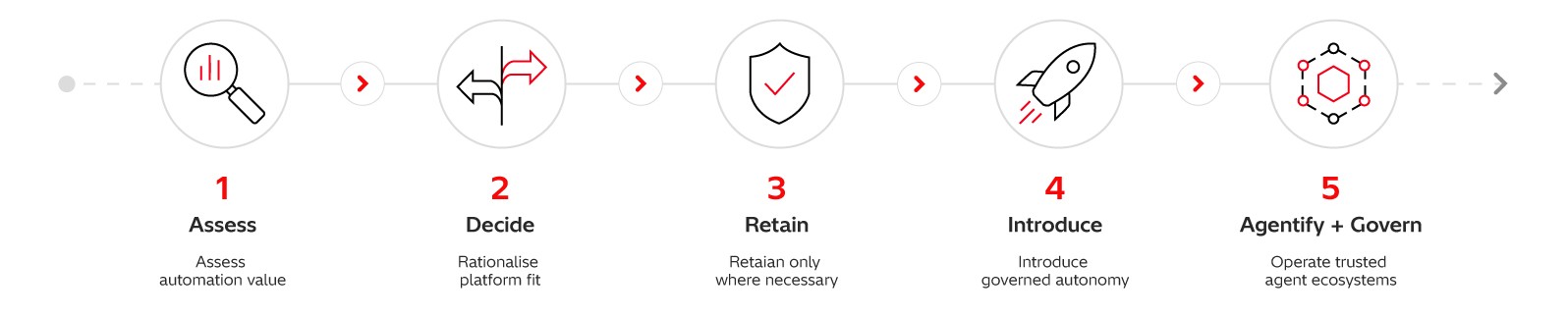
A practical transition path
from bot estates to managed agentic operations
Why Hitachi Digital Services
Managed outcomes
for the shift to
agentic operations
Hitachi helps organisations make the shift safely, commercially and at enterprise scale. Our managed services model adds governance, observability, drift control, reliability SLOs and continuous optimisation through HARC for AI and R2O2.ai—so you can innovate with confidence and operate with control.

Governed
Built-in governance and compliance by design.

Observable
End-to-end visibility and telemetry across agents and workflows.

Reliable
Drift control and reliability SLOs you can trust.

Adaptive
Continuously optimise performance and cost to outcomes.

Human-in-the-loop
Oversight, approvals and accountability where it matters.

Ready to take the next step?Let’s assess, rationalise and evolve your automation estate—so you can govern, optimise and scale agentic operations with confidence.
How We Work
A practical transition path from bot estates to managed agentic operations

Managed outcomes for the shift to agentic operations
Hitachi helps clients make the shift safely, commercially and at enterprise scale, reinforced by a managed services model that adds governance, observability, drift control, reliability SLOs and continuous optimisation through HARC for AI and R2O2.ai.




Related Content