February 19, 2026


Speakers:
Mark Williams : Senior Director & Head of Retail, Hospitality & Travel, Hitachi Digital Services, EMEA
Dave Kost : Vice President, Software Engineering Maintenance & HR Systems, Penske
Rajesh Devnani : Vice President – Energy and Utilities, Hitachi Digital Services
Michael Hernandez : Senior Manager Consulting Lead, Hitachi Digital Services
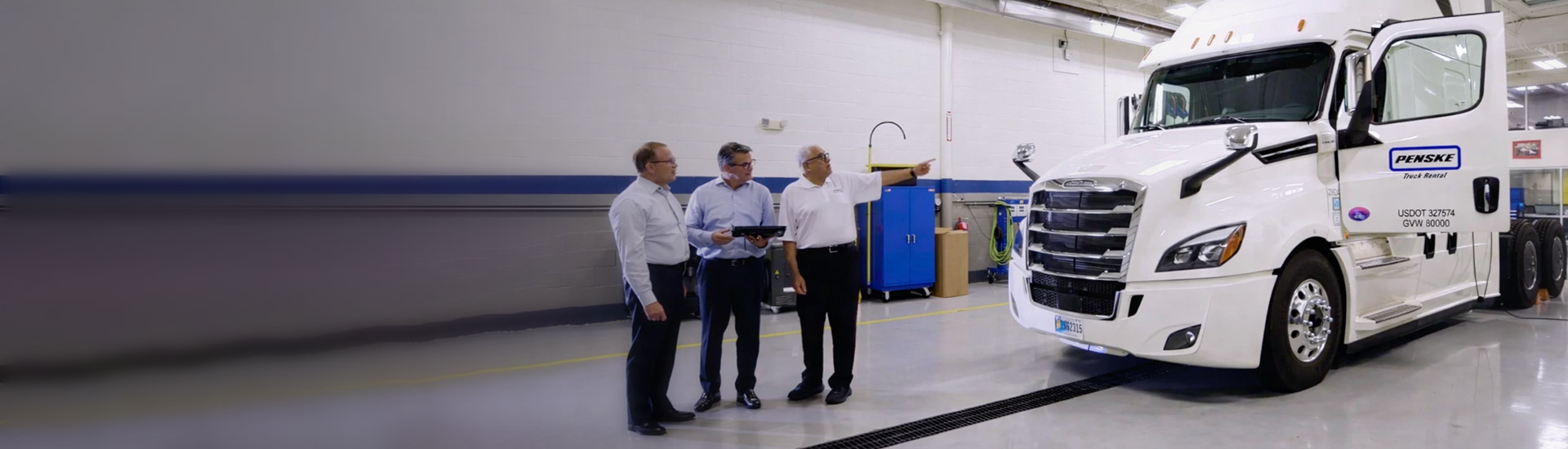
In this webinar, leaders from Hitachi and Penske Transportation Solutions explored how AI and advanced data integration are transforming large-scale fleet operations. Against the backdrop of growing vehicle complexity, technician shortages, and rising operational costs, the discussion focused on how Penske is shifting from reactive maintenance to predictive, intelligence-driven service models. The session highlighted three core innovations—Guided Repair, Proactive Diagnostics, and AI-powered visual inspection—demonstrating how data, when embedded directly into workflows, can improve uptime, reduce costs, and enable technicians to operate with greater speed and precision.
At the center of this transformation are three AI-driven solutions developed through a long-standing co-creation partnership. Together, they modernize how nearly 400,000 vehicles are diagnosed, maintained, and inspected—moving maintenance from reactive response to predictive performance management.
1. Guided Repair (AI-Assisted Diagnostics)
Guided Repair addresses one of the industry’s most persistent challenges: correctly identifying the root cause of increasingly complex vehicle issues on the first attempt. Modern trucks contain advanced emissions systems, sensors, and software logic, making diagnostics more time-consuming—especially amid a shortage of experienced technicians.
The Guided Repair model is trained on historical repair orders, fault codes, complaints, and vehicle attributes. When a technician connects to a truck and downloads fault codes, the system automatically activates and provides targeted diagnostic guidance. Rather than recommending part replacement, it directs technicians to inspect specific systems or assemblies most likely causing the issue.
The results are significant:
- 87% diagnostic accuracy
- 76% adoption across 900 repair locations
- Approximately $2 million in annualized savings
Beyond cost savings, the tool standardizes expert-level diagnostics across all shops, reduces repeat repairs, shortens service times, and improves customer uptime.
2. Proactive Diagnostics (Predictive Maintenance at Scale)
While Guided Repair improves outcomes once a truck is in the shop, Proactive Diagnostics aims to prevent roadside failures entirely. This system operates as a “model of models,” leveraging more than 200 machine learning models tailored to various truck types, duty cycles, and operating environments.
Processing approximately 95,000 engine-related fault events daily, the platform performs dual-stream analysis:
- Predicting time-to-failure (when)
- Identifying the likely failing component or system (what)
If a critical pattern is detected, a service request can be generated within 10 minutes of a fault occurring in the field. This allows Penske to schedule maintenance before a breakdown disrupts customer supply chains.
The operational impact includes:
- Roughly $17 million in annual cost avoidance
- Reduced emergency road calls
- Lower labor and third-party vendor costs
- Improved uptime and predictability
A centralized Control Center monitors model performance and applies business rules to manage alert noise and customize responses by customer segment.
3. AI Fleet Visual Inspection (Automated Damage Detection)
Currently in pilot phase, this solution modernizes the manual inspection process during rental check-in and check-out. Camera systems automatically identify vehicles and detect dents, scratches, or missing parts, even in hard-to-see areas such as truck roofs. The system compares current images to historical records to determine whether damage is new.
This improves billing accuracy, reduces disputes, accelerates turnaround time, and integrates directly into maintenance workflows.
Collectively, these three solutions demonstrate a strategic shift toward AI-enabled fleet intelligence – enabling technicians, reducing variability, and transforming maintenance from reactive repair to predictive performance management.
Here’s a short AI-generated podcast for you to listen to: