Build Resilient
Supply and
Service Execution

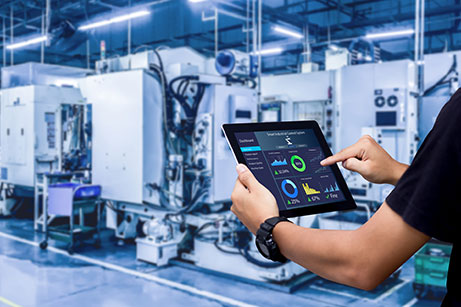
Manufacturers must respond faster to disruption across supply networks, logistics, and operations while improving uptime and customer service. Hitachi Digital Services connects supply chain, field service, and enterprise systems (ERP, cloud, data) across distributed operations, embedding intelligence into daily execution to enable real-time responsiveness and resilience, and better cost control from planning through to service delivery.

Let’s talk
Build Resilient Supply and Service Execution
Challenge & Opportunity

See Disruption Earlier. Respond Faster.

Manufacturing networks face demand volatility, supplier risk, sustainability pressures, and logistics complexity. Many struggle with aging ERP platforms, manual planning, disconnected field service workflows, limited visibility, and reactive maintenance models. The opportunity is to connect supply, maintenance, and service systems through predictive intelligence, digital twins, and integrated platforms – improving reliability, responsiveness, and cost control without adding complexity.

Solution
Connected Solutions for Supply Chain, Service, and Enterprise Performance
We improve supply chain and service performance across four areas – supply chain optimization, predictive maintenance, enterprise platforms, and connected service – enabling real-time, data-driven decision-making. We also address sustainability across supply chains, including Scope 3 visibility, emissions tracking, and resource optimization, through connected data platforms.

Scenario-Driven Supply Chain Decisions

SCO digital twins enable manufacturers to anticipate disruption, test scenarios, and optimize inventory, production, and distribution decisions in real time.

Scenario-Driven Supply Chain Decisions
  • Scenario Planning
    Model supply chain disruptions and demand shifts to respond faster and with greater confidence
  • Inventory Optimization
    Improve service levels while reducing cost through optimized inventory positioning and replenishment strategies
  • Network Visibility
    Gain insight across suppliers, plants, and logistics networks to identify risks early
  • Constraint Modeling
    Simulate capacity, transport, and supplier constraints to support better planning decisions
  • ERP Integration
    Embed digital twin insights into ERP and planning systems to accelerate decision-making
  • Decision Speed
    Reduce time-to-decision through integrated, real-time planning intelligence

Uptime, Reliability, and Cost Control

We enable predictive and condition-based maintenance by integrating asset data, analytics, and enterprise workflows to reduce downtime and improve service performance.

Uptime, Reliability, and Cost Control
  • Failure Prevention
    Use predictive analytics on IoT and operational data to identify risks before equipment failures occur
  • Condition Monitoring
    Trigger maintenance actions based on real-time thresholds rather than fixed schedules
  • Cost Reduction
    Reduce emergency interventions and unnecessary maintenance to improve cost efficiency
  • Asset Availability
    Improve uptime by aligning maintenance activities with operational requirements
  • Workflow Integration
    Connect insights to execution through EAM, APM, and field service systems
  • Planning Alignment
    Ensure maintenance decisions align with production and supply chain priorities

Resilient Operational Foundations

Enterprise platforms enable scalable, secure, and responsive supply chain and service operations across manufacturing networks.

Resilient Operational Foundations
  • ERP Modernization
    Transform SAP S/4HANA and ERP systems to improve planning, execution, and operational visibility
  • Cloud Scalability
    Enable flexible, scalable supply chain platforms through hybrid and cloud architectures
  • Operational Resilience
    Improve uptime and performance of mission-critical systems through SRE and managed services
  • Security Compliance
    Strengthen cybersecurity across enterprise and operational environments to reduce risk and ensure compliance
  • Data Visibility
    Unify enterprise and operational data to support real-time decision-making
  • Platform Stability
    Deliver consistent, reliable system performance across distributed manufacturing environments

Faster, Smarter Service Execution

We embed intelligence into service workflows to improve response speed, reduce repeat repairs, and ensure consistent service outcomes.

Faster, Smarter Service Execution
  • Real-Time Insight
    Use Industrial Edge and IoT to deliver actionable insights at the point of service
  • Fault Detection
    Improve diagnosis through connected asset telemetry and operational data integration
  • Service Coordination
    Optimize dispatch, parts availability, and logistics across distributed service operations
  • Repair Efficiency
    Reduce repeat repairs through guided workflows and standardized execution
  • Data Integration
    Connect ERP, MES, and service systems to enable coordinated operational decisions
  • Scalable Analytics
    Use MLOps to operationalize predictive insights consistently across sites and service environments

Additional Solutions

Cross-Cutting Cloud, Data, IIoT, AI and Cybersecurity Capabilities

Cloud Modernization

Transform ERP, planning, and service platforms into scalable, reliable cloud ecosystems.

Hitachi Application Reliability Centers

Drive resilience with Site Reliability Engineering (SRE), and HARC operations

Cybersecurity for IT–OT Networks

Zero-trust architecture and ISA/IEC 62443 alignment

Data, AI and Industrial IoT

Unified data models and predictive analytics for supply chain and service

Customer Story

Penske Improves Fleet Uptime with AI-Driven Guided Repair

Increasing fleet uptime and preventing 90,000+ breakdowns with AI-driven diagnostics.

Penske Improves Fleet Uptime with AI-Driven Guided Repair
Customer Story

Rail Manufacturer – AI Inspection Transformation

80–90% faster inspections and improved quality using computer vision and robotics.

Rail Manufacturer – AI Inspection Transformation
How We Work

A connected model for supply chain, service, and enterprise systems.

 

Advisory

SCO strategy, service transformation, ERP roadmaps

Implementation

Digital twins, predictive maintenance, SAP PM

Transformation

Cloud, IoT, and enterprise modernization

Managed Services

SRE, cloud operations, HARC reliability

Why Hitachi Digital Services
  • ET–IT–OT strength across supply chain and service
  • Industrial AI tested across rail, energy, manufacturing, logistics
  • Proven frameworks for SCO, predictive maintenance, and ERP
  • Proven solutions: WEF recognized, Lighthouse-grade innovation across 200+ Hitachi factories
  • Recognized by ISG as a Product Challenger in Manufacturing Services and Solutions Read the report

Our Experts Our Experts
Our Experts
Anupam Bhatnagar
Anupam Bhatnagar
Head of Manufacturing & Consumer Industries
linkedin
Sankar Natarajan
Sankar Natarajan
Practice Head, Digital PLM & Smart Manufacturing
linkedin
Ajay Thakur
Ajay Thakur
Head of Process Manufacturing
linkedin
Ram Chivukula
Ram Chivukula
Head of Discrete Manufacturing
linkedin

Partners

and logistics and industrial ecosystem partners

INSIGHTS
The Value of an Integrated ET-IT-OT Approach Insights

The Value of an Integrated ET-IT-OT Approach

The AI Revolution in Manufacturing: How to Lead the Charge Insights

The AI Revolution in Manufacturing: How to Lead the Charge

The Future of Digital PLM - How AI and Digital Thread are Redefining Product Development and Operations Insights

The Future of Digital PLM - How AI and Digital Thread are Redefining Product Development and Operations

FAQ

Supply chain planning improvement focuses on optimizing decisions – inventory levels, network design, and demand–supply alignment. Execution improvement focuses on real-world performance – supplier disruption, transport delays, plant constraints, and service responsiveness. Manufacturers need both. Planning must translate into executable actions, while execution systems must feed real-time performance data back into planning. This closed-loop approach improves forecast accuracy, responsiveness, and operational resilience across the supply chain.

A supply chain digital twin models constraints and trade-offs across suppliers, production sites, inventory, logistics, capacity, and demand variability. It enables scenario-based decision-making in real time. Day-to-day, teams use digital twins to test supply reallocation, reroute logistics, rebalance inventory, prioritize orders, and evaluate cost versus service trade-offs. When integrated with ERP and planning systems (including SAP), digital twins accelerate decision-making and improve supply chain agility under volatility.

Factory execution directly impacts supply chain and service outcomes through throughput, schedule adherence, material availability, and quality. However, MES/MOM systems are often isolated from supply chain and service workflows. By connecting MES/MOM with ERP, supply chain, and service platforms, manufacturers gain real-time visibility into constraints and performance issues. This enables faster coordination across planning, production, logistics, and service teams, reducing disruption and improving end-to-end operational performance.

Predictive maintenance works when the full chain is connected – from asset telemetry to actionable execution. This includes sensor data, SCADA and historian signals, analytics models, and integration with EAM/APM systems. The goal is not just prediction accuracy, but operational impact. Insights must trigger work orders, prioritization, and scheduling decisions. When integrated properly, predictive and condition-based maintenance reduce downtime, improve asset reliability, and optimize maintenance costs.

Connected Service Operations unify data and workflows across ERP, MES/MOM, supply chain, and service platforms to enable real-time decision-making. This integration improves parts availability, dispatch coordination, repair prioritization, and service execution consistency. The result is faster response, fewer repeat repairs, and improved reliability – especially in distributed manufacturing and asset-intensive environments.

Scaling AI requires robust MLOps – including governance, monitoring, version control, and performance management. Without it, models degrade, outputs become inconsistent, and trust declines. With MLOps, manufacturers can deploy and maintain AI models reliably across sites. This ensures consistent decision intelligence for supply chain planning, predictive maintenance, logistics optimization, and continuous improvement at scale.

HARC (Hitachi Application Reliability Center) is a managed services model that applies Site Reliability Engineering (SRE) practices to cloud operations and apps across manufacturing and supply chain environments. It ensures reliable performance of critical systems such as production planning, logistics, and after-sales service platforms. By combining SRE-led monitoring, automation, and incident management, HARC helps reduce downtime, improve system responsiveness, and maintain continuity across connected operations. This enables manufacturers to stabilize supply chains, enhance service delivery, and scale digital capabilities with greater confidence, efficiency, and operational resilience.