Vitor Domingos
Head of AI - EMEA
Centre for Architecture & AI

Premkumar Balasubramanian
CTO and Global Head of AI
August 17, 2026


The Outcome-Forward Engineering manifesto argues that agentic tools raise the value of clear intent, bounded work, evidence, and operational ownership.
Generative AI has made technical activity cheap. Code, tests, diagrams, migration plans, and pull-request prose can now appear in minutes. For engineering leaders, that abundance creates a new failure mode: an organisation can move faster while becoming less certain that it is moving in the right direction.
Outcome-Forward Engineering, or OFE, starts with this concern. Our manifesto rejects prompts written, agents launched, branches created, and ceremonies completed as measures of progress. It begins with a measurable change in a business, operational, customer, or engineering result, then works backward.
What capability must exist? What conditions define completion? What evidence would convince a skeptical operator, security lead, architect, product owner, and finance executive?
OFE is a management system for engineering judgment in a world where implementation is becoming abundant.
Code is no longer the bottleneck
Traditional delivery models assume implementation is the scarce step. Agentic systems weaken that assumption. They can generate software faster than many organisations can frame the problem, assess the risk, or inspect the result.
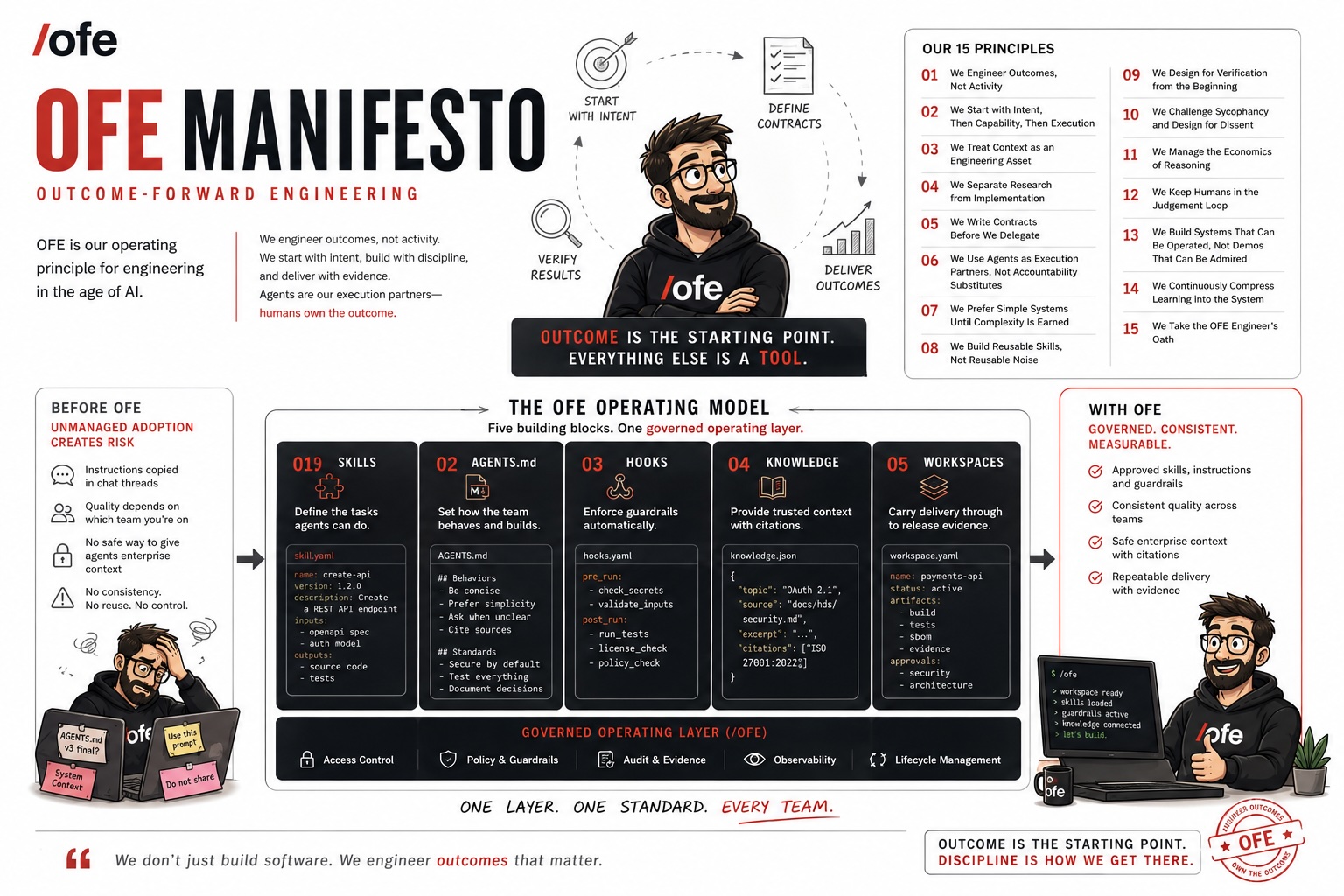
The OFE Manifesto therefore puts intent, outcome, and capability ahead of execution. A contract defines the completion conditions. Verification produces evidence. Learning turns the useful parts of a delivery into a rule, skill, or repeatable pattern.
This sequence can look formal, but it addresses a practical failure. A poorly framed task does not become well framed when it is handed to a more capable model. It simply produces a larger volume of plausible work.

For engineers, the first investment question becomes whether the work is clear enough to delegate. Platform selection comes later. A rule, script, workflow, or API call may solve the problem more reliably than an agent. A single agent may be sufficient where a multi-agent architecture would add coordination costs and new failure modes.
The manifesto’s hierarchy is deliberately conservative: establish manual clarity before automation, use automation before agents, prefer a single agent before a multi-agent system, and write the contract before designing the orchestration. This also limits vendor-led architecture. Models and frameworks will change. A measurable outcome, explicit boundary, and verification contract can survive the replacement of the tool.
Context becomes part of the architecture
Agents are sensitive to context, but the usual response has been to give them everything: entire repositories, long instruction files, old decisions, and every document that might be relevant. More context can mean more ambiguity. It increases processing cost and gives obsolete information the same apparent authority as current decisions.
OFE treats context as a curated engineering asset. A useful context package states the expected outcome, scope boundary, constraints, minimum current-state knowledge, prior decisions, verification criteria, and exit condition. Additional material must justify the attention it consumes. This makes context design an architectural responsibility. Someone must decide which facts are authoritative, which constraints are mandatory, and which decisions have already been made. Prompt writing is the smallest part of that job.
The manifesto’s most consequential operating rule is be the separation of research from implementation. Research surfaces options and trade-offs. Architecture records a decision. Implementation executes it. Verification tests it. Combining these jobs in one agent session allows an unmade decision to harden quietly into code. When a model can generate a large change in minutes, the cost of a weak premise may arrive before the team notices.
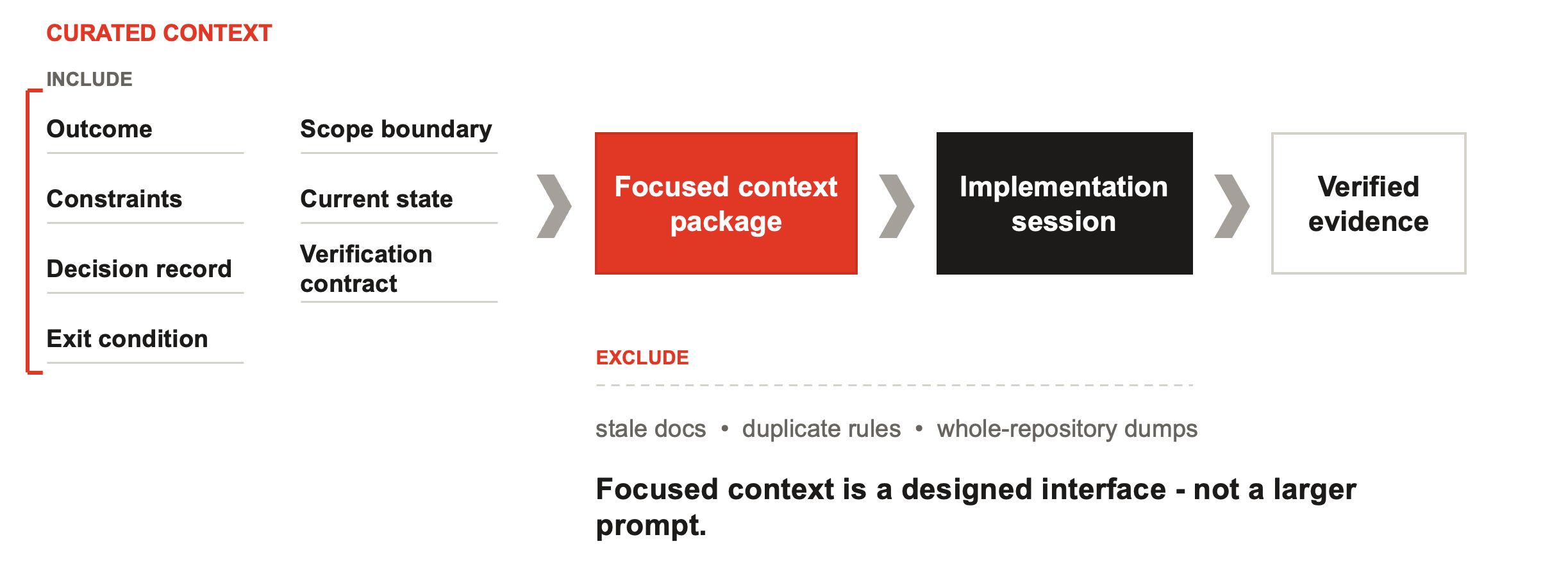
A clean separation creates a small handoff, but it reduces the chance that exploration, preference, and implementation will become indistinguishable. That matters when the output can look polished long before its assumptions have been tested.
Autonomy needs an exit contract
Agents are usually good at starting. They are less reliable at deciding when to stop.
An OFE task is ready only when its exit conditions are explicit: the agreed behaviour works, tests pass, nonfunctional constraints are met, architecture and security rules have been checked, evidence is attached, and the outcome impact can be traced.
For an engineer, this contract is the control plane. It establishes a safe operating envelope without prescribing every keystroke. It also places human judgment at the points where consequences are material: intent, ethics, architecture, financial exposure, production readiness, and organisational impact.
A human-in-the-loop control is weak if the human only approves an output after the important choices have already been made. Human involvement has to occur where judgment can still change the direction of the work.
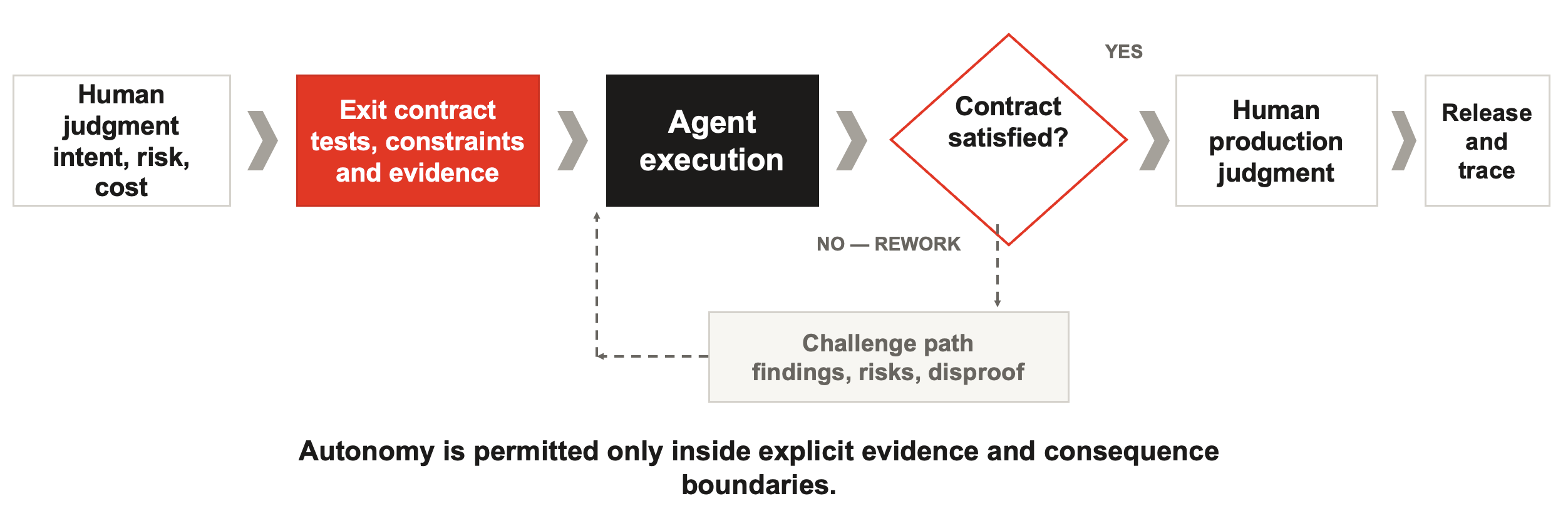
The same discipline applies to dissent. Agents often accommodate the premise placed in front of them. The manifesto recommends asking for findings, trade-offs, risks, disproof, and evidence. Important decisions need a challenge path because an agreeable machine can accelerate a weak idea as easily as a sound one.
The real test starts after the demo
Most agentic AI programs can produce a compelling prototype. OFE asks whether the resulting system can be operated.
Can teams trace decisions, tool calls, failures, and cost? Are service levels, fallbacks, escalation paths, identities, approvals, and support procedures defined? Can behavioural, data, and cost drift be detected before users absorb the damage? These questions expose the distance between generated software and an engineered system. A prototype proves that something can work under favourable conditions. A production system must remain understandable when those conditions fail.
The economic argument deserves equal attention. Reasoning is a finite resource. Tokens, context, retries, tool calls, evaluations, monitoring, compute, and storage create a new delivery cost structure. Without outcome-centered accounting, teams can optimise for impressive capability while hiding waste inside orchestration.
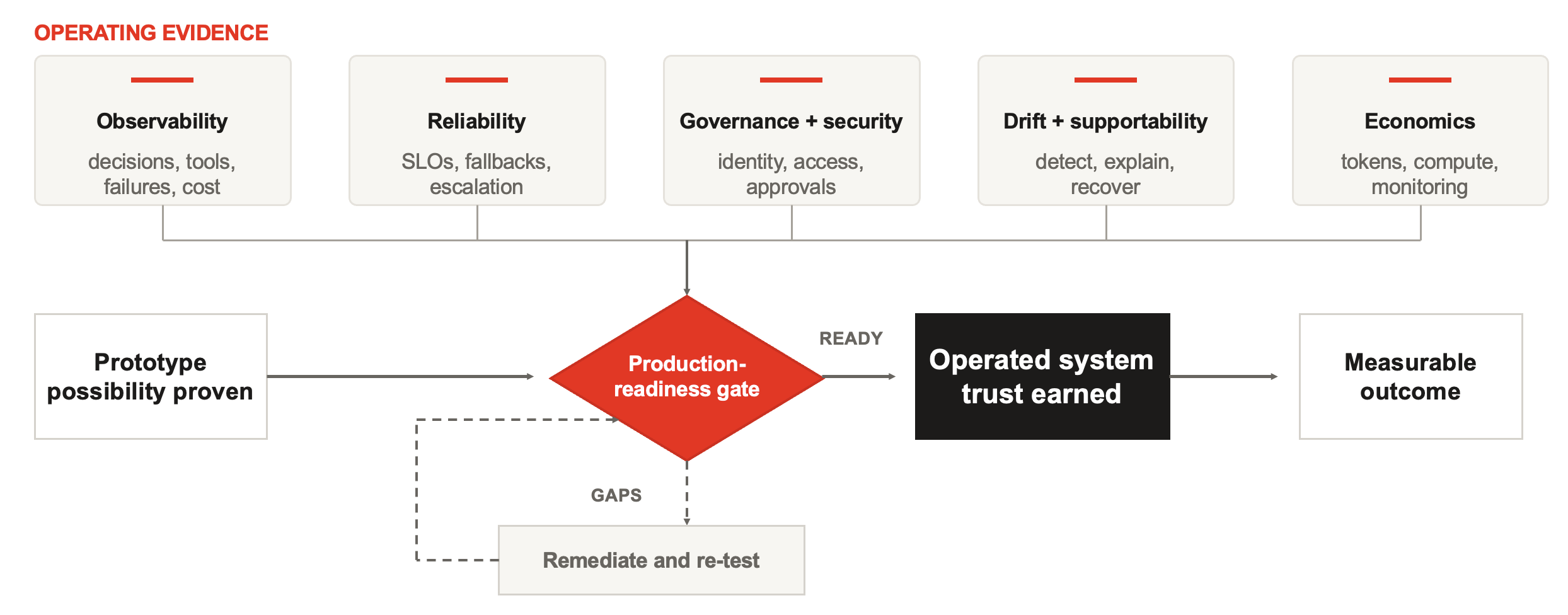
AI FinOps therefore belongs inside engineering. Cost is part of production behaviour and should be visible during design, testing, and operation. The manifesto’s preference for simple systems follows from this economics. Every layer of autonomy adds failure modes, observability requirements, governance work, and operating cost. Complexity has to repay that burden through a measurable improvement in the outcome.
A mature engineering system should get lighter
OFE ends with a maintenance discipline: compress what a team learns into governed rules, skills, contracts, and patterns, then remove what has become redundant or contradictory. The aim is a delivery system that becomes lighter over time. Organisations are good at accumulating controls. They are less practiced at retiring instructions, evidence templates, and agent machinery that no longer improve the result.
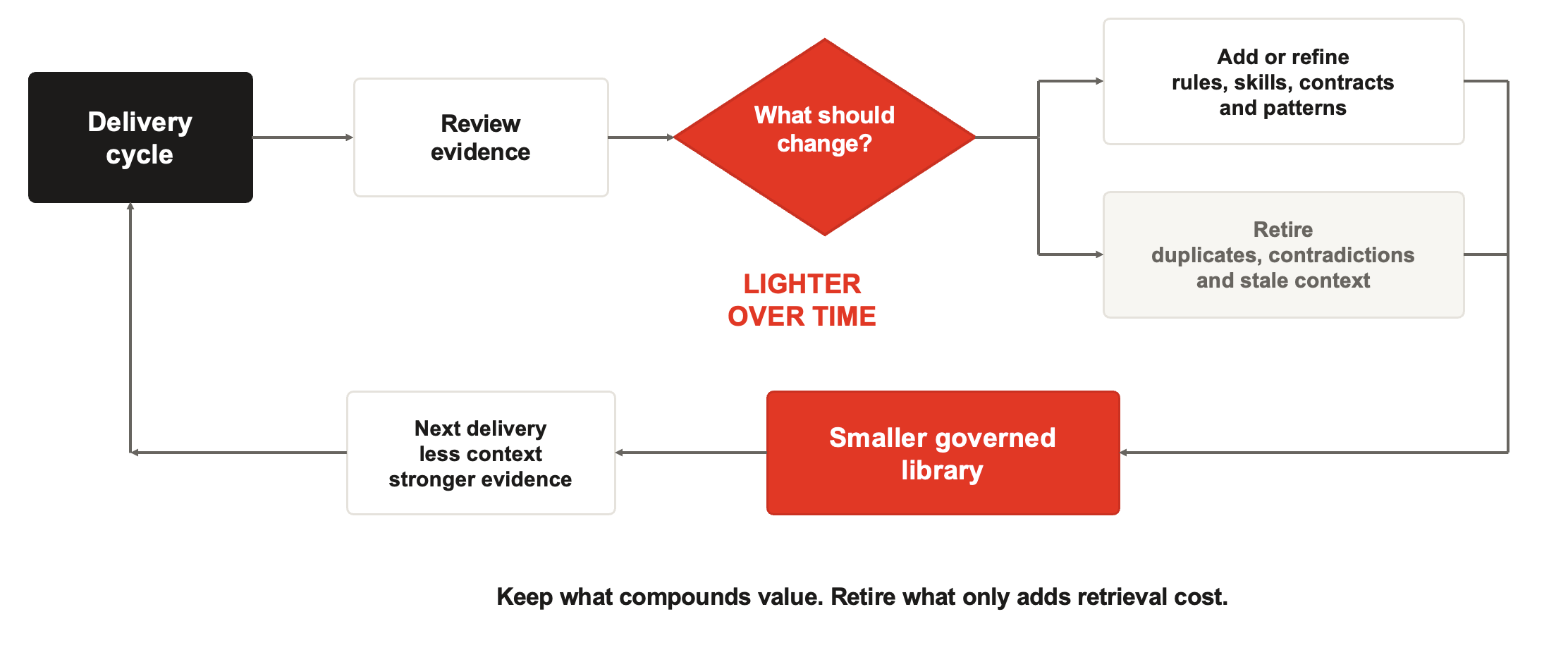 Agentic engineering concentrates the need for senior judgment. When implementation becomes abundant, clarity over intent, boundaries, evidence, cost, and operability becomes the source of leverage. Agents can accelerate execution, inspection, and learning. Executive engineers still own what the system is for, what it may do, and why anyone should trust it.
Find our OFE Manifesto here to download: